
Inductors are vital components in electrical circuits, used to store energy in the form of a magnetic field. They play a key role in filtering signals, managing energy storage, and controlling current flow. Whether you are designing a power supply, an amplifier, or a complex filter, selecting the right custom inductor geometry is crucial for achieving peak performance.
Two of the most common core geometries are E-Cores (and bobbins) and Toroidal cores. Understanding the mechanical and electromagnetic differences between these shapes will guide you in selecting the most suitable configuration for your project.
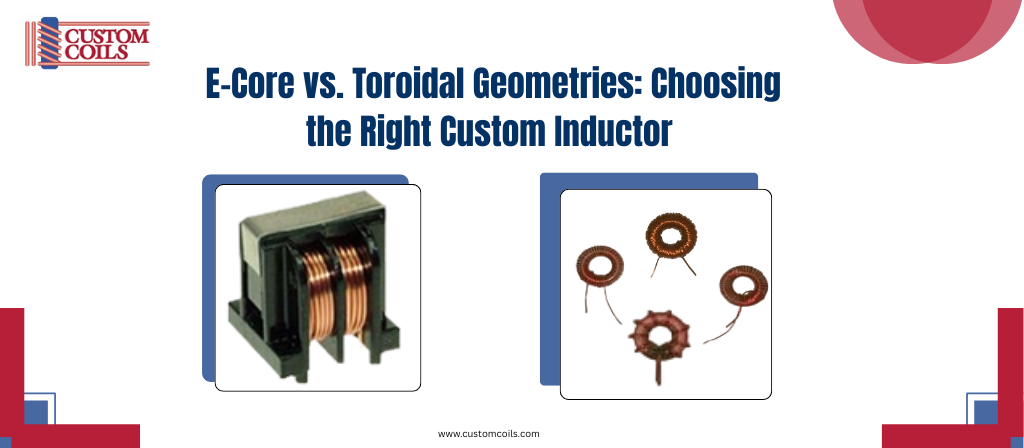
Understanding the Geometries
Traditional E-Core and Bobbin Inductors
Traditional inductors often utilize E-Core or bobbin-style geometries. These typically use ferrite, a ceramic compound with high magnetic permeability, to concentrate the magnetic field and store energy efficiently.
These designs are lightweight and highly effective for high-frequency applications, helping to reduce energy losses and minimize unwanted noise. Because they are easy to wind, they are a staple in power supplies, filters, and various audio equipment. However, because they often have an ‘open’ magnetic path, they are more prone to electromagnetic interference (EMI) leakage.
Toroidal Inductors
Unlike the multi-piece assembly of an E-Core, a toroidal inductor uses a continuous, doughnut-shaped core. This core can be made from either iron powder or ferrite materials.
The primary advantage of the toroidal shape is its ‘closed-loop’ design. This geometry confines the magnetic field within the core, which drastically reduces EMI and radiation. Due to their compact size and low-loss characteristics, toroidal inductors are preferred for high-performance power supplies and transformers where efficiency is a priority.
Geometry Comparison: E-Core vs. Toroidal
When deciding on a custom inductor, the choice of shape impacts everything from board space to interference levels. Here is how the two geometries compare:
| Feature | E-Core / Bobbin Inductor | Toroidal Inductor |
| Magnetic Path | Open or gapped structure; leads to higher EMI leakage. | Closed-loop design; contains the magnetic field and minimizes EMI. |
| Efficiency | Highly efficient at high frequencies; ideal for low-to-medium power. | Exceptionally efficient with very low core losses across a wide range. |
| Power Handling | May have limited power handling depending on the gap and size. | Superior magnetic flux management; improves power handling capabilities. |
| Size & Weight | Lightweight and compact; ideal for portable or small electronics. | Denser and more compact; the doughnut shape saves board “real estate”. |
| Common Uses | High-frequency filtering and devices with minimal interference concerns. | Transformers, power inductors, and inductive heating where low EMI is critical. |
Partner With a Trusted Custom Inductor Manufacturer
As a specialist in the field, Custom Coils provides a wide range of solutions, including ferrite-based E-cores and high-performance toroidal power inductors designed to meet your specific requirements. Whether you are developing a specialized filtering solution or a high-efficiency transformer, our team delivers components engineered for long-term reliability.

Explore our range of custom inductors today to find the geometry and material combination that will enhance your system’s performance and reduce interference.