
When it comes to electrical power conversion, understanding the difference between inverters and transformers is crucial. Both play key roles in power electronics, but they serve distinct purposes. While a transformer adjusts voltage levels in AC circuits, an inverter enables DC-AC conversion, allowing for the use of solar energy and battery storage, particularly during power outages. This post highlights the core differences between inverters and transformers, their applications, and offers guidelines to help you decide the best-suited option for your electrical needs.
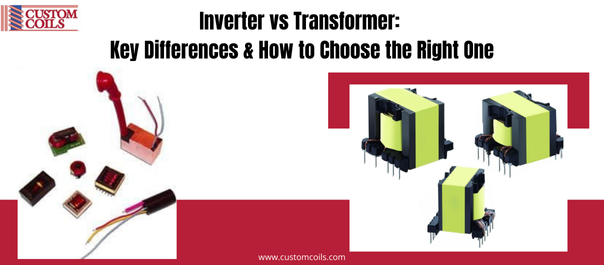
Inverter vs Transformer: Differences Explained
Here are some differentiating factors between inverters and transformers.
| Aspect | Transformer | Inverter |
| Function | It’s a passive electrical device that transfers AC power between circuits via electromagnetic induction. It steps up or steps down the voltage as required. | Active electronic device that converts DC power to AC power. Used largely in solar panels, batteries, and more in homes and industries. |
| Input/output type | It requires an AC input and provides an AC output. The output voltage is proportional to the input by the turns ratio of its coils. | It takes a DC input and produces an AC output. Essentially creates an AC waveform from a DC supply, with standard output voltages/frequencies as needed. |
| Size and weight | Generally bulkier and heavier for a given power rating. Especially at line frequencies (50–60 Hz), transformers require large iron cores and substantial copper windings. | Typically compact and lighter for equivalent power output. Using high-frequency electronics instead of large iron cores allows inverters to be much smaller and portable. |
| Output waveform | Same as input waveform: The transformer does not alter the shape of the AC waveform. | It has synthesized AC waveform means the inverter actively generates the AC waveform, so output quality depends on design. High-end inverters produce grid-quality sine waves, while basic models may output square or stepped waves. |
| Common components | Common components are coils & core. Transformers comprise a primary winding and one or more secondary windings wound on a common magnetic core (iron or ferrite). | Built from semiconductor switches arranged in an inverter bridge (transistors like IGBTs/MOSFETs that switch DC), control logic circuits to regulate switching, and filtering components (inductors/capacitors) to smooth the output waveform. |
Things to Consider While Selecting Inverters or Transformers
Here are some key points to keep in mind for each, when selecting an inverter or transformer.
- Requirement vs. power rating: Assess the total power needs of your system to ensure the selected device can handle the load. Inverters and transformers come in various power ratings, so choose one that aligns with your requirements.
- Voltage compatibility: Make sure the input and output voltage and frequency are compatible with your electrical system. Transformers are designed to handle specific AC voltage levels, while inverters must convert DC to the appropriate AC voltage and frequency.
- Efficiency: Look for high-efficiency models, especially for long-term use. Inefficient units can waste energy and increase operational costs. Inverters and transformers should both minimize losses to improve performance.
- Size and dimensions: Depending on the space available and mobility needs, consider the physical dimensions and weight of the device. Inverters tend to be more compact, while transformers can be bulky and heavy. There are compact transformers too, depending on their type.
- Application requirement: Identify whether you need an inverter or transformer based on your specific application. Inverters are crucial for DC to AC conversion in renewable energy systems, backup power, and electronic devices, while transformers are essential for voltage regulation in power distribution systems.

Looking for tailored transformer solutions that meet your specific power conversion requirements? Look no further than Custom Coils. They offer high-quality, efficient, and reliable products that ensure optimal performance. Contact our team today to learn more!