
A step down transformer reduces a higher AC voltage to a lower voltage for distribution, equipment, and end-use applications. Utilities transmit power at high voltage to reduce resistive losses over long distances, then lower the voltage in stages at substations and distribution points until it matches what buildings and equipment are designed to accept.
This guide explains the relationship between voltage and current, turns ratios, VA sizing, step down transformer applications, common 220V to 110V configurations, transformer specifications, and when a custom-built transformer may be a better choice than a standard unit.
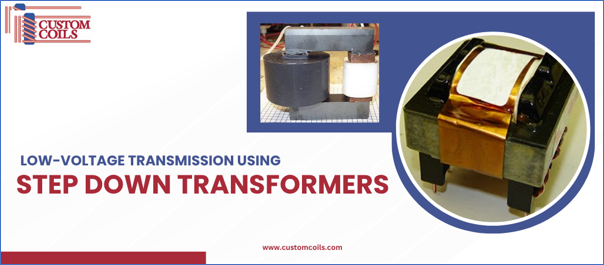
Why Is Voltage Stepped Down Before Power Reaches End Users?
Bulk electrical power is transmitted at high voltage because higher voltage allows the same amount of power to be transferred at lower current. This helps reduce resistive I²R losses in transmission conductors.
A simplified sequence is:
Generation → Step-up → High-voltage transmission → Substation step-down → Distribution → Further voltage reduction → End-use equipment
Step down transformers therefore play an important role in reducing voltage at substations, distribution points, and equipment-level applications.
Although the title refers to “low-voltage transmission,” bulk electricity is generally transmitted at high voltage. The step-down process takes place as electricity moves from the transmission system toward lower-voltage distribution and end-use equipment.
What Happens to Current When Voltage Is Stepped Down?
Step down transformer current generally increases as voltage decreases when approximately the same amount of power is transferred.
The basic relationship is:
P ≈ V × I
For an ideal transformer, input power and output power are approximately equal. Therefore, when voltage is reduced, the secondary side can deliver proportionally higher current.
For example, if the voltage is reduced from 220V to 110V, the ideal secondary current can be approximately twice the primary current for the same power level.
Real transformers have core, winding, and other losses, so output power is slightly lower than input power. The actual current capability depends on the transformer’s efficiency, winding design, thermal characteristics, and VA/kVA rating.
Step Down Transformer Turns Ratio
The step down transformer turns ratio determines the relationship between the primary and secondary voltage.
The ideal relationship is:
Vp / Vs = Np / Ns
For a step down transformer 220v to 110v, the ideal voltage ratio is:
220 / 110 = 2:1
For example, a transformer could have 400 primary turns and approximately 200 secondary turns to produce this ideal ratio. However, actual winding counts depend on the magnetic core, operating frequency, flux density, regulation requirements, and overall transformer design.
The turns ratio provides the basic voltage relationship, but the final transformer design involves more than simply dividing the winding turns.
How Do You Calculate Transformer VA?
VA, or volt-amperes, indicates the apparent-power capacity of a transformer.
For a single-phase load:
VA = Voltage × Current
For example, a 110V secondary supplying a continuous 10A load requires:
110V × 10A = 1,100 VA
This calculation provides a starting point for transformer sizing. The final transformer rating should also take into account factors such as:
- Inrush current
- Continuous versus intermittent operation
- Duty cycle
- Ambient temperature
- Load characteristics
- Thermal requirements
- Future load requirements
The correct transformer is therefore not necessarily the one with the largest VA rating. It should be sized appropriately for the actual application.
Where Are Step Down Transformers Used?
Step down transformer applications include industrial, commercial, control, instrumentation, and equipment-level power systems.
Industrial and Commercial Equipment
Step down transformers can supply equipment that requires a lower voltage than the available facility supply.
Control Systems
Lower-voltage power may be required for control panels, instrumentation, sensors, and other industrial control circuits. Applications specifically designed around control circuits may be better suited to control transformers, depending on the electrical requirements.
Ignition Systems
Specialized transformer designs can be used in ignition applications where specific voltage, current, insulation, and physical requirements need to be met. Custom Coils also provides DC igniter solutions for applicable ignition systems.
Small Power Applications
Lower-VA transformers can be used in instrumentation, sensing, control, and other equipment where a lower AC voltage is required.
Isolation Applications
A 1:1 isolation transformer does not intentionally reduce voltage. Its primary purpose is to provide electrical separation between circuits. Some transformer designs can combine voltage reduction and isolation when the application requires both.
Step Down Transformer Specifications
The step down transformer specifications depend on the required input voltage, output voltage, current, ratio, outputs, isolation, and physical configuration.
Custom Coils’ step down transformers are designed with high input voltage and low output voltage. Available output voltage examples include 110V, 24V, 20V, 10V, and other values based on application requirements. The primary winding handles the higher-voltage input, while the secondary winding is designed for the required output current.
Custom configurations can include:
- Custom turns ratios
- Specified input and output voltages
- Single or multiple outputs
- Electrical isolation
- Flying leads
- PC-mount configurations
These configurations are explicitly listed by Custom Coils.
Step-Up Transformers vs. Step Down Transformers
A step up and step down transformer use the same fundamental electromagnetic-induction principle but perform opposite voltage transformations.
| Feature | Step Down Transformer | Step-Up Transformer |
| Voltage | Decreases | Increases |
| Current | Increases approximately | Decreases approximately |
| Secondary turns | Fewer than primary | More than primary |
| Typical use | Distribution and equipment supply | Increasing voltage for transmission |
| Example | 220V → 110V | 110V → 220V |
The current relationship assumes approximately the same transferred power and depends on transformer efficiency in an actual application.
Some step up step down transformer designs can support voltage conversion in either direction through an appropriate winding configuration. This capability must be specified during the design stage rather than assumed.
Choosing a Step Down Transformer Manufacturer
Look for a step down transformer manufacturer that provides direct engineering support during design, documented testing, and experience with application-specific transformer requirements. Custom Coils’ engineers work with buyers from design through manufacturing, with production testing performed before shipment.
As a step down transformer supplier, Custom Coils provides engineering and manufacturing support for custom transformer requirements.
Request a quote for a custom transformer to discuss your voltage, current, VA, dimensional, and application requirements with the Custom Coils team.
Frequently Asked Questions
What is a step down transformer?
A step down transformer reduces a higher AC voltage to a lower AC voltage while increasing the available current for approximately the same transferred power.
Can a step down transformer convert 220V to 110V?
Yes. A properly designed 220V to 110V step down transformer can reduce a 220V AC supply to approximately 110V AC, provided the transformer’s current, VA rating, frequency, insulation, and other specifications are suitable for the application.
What happens when a step down transformer is overloaded?
Overloading can increase winding temperature, voltage drop, and insulation stress. Prolonged operation above the rated capacity can accelerate insulation aging and reduce service life.
When do I need a custom step down transformer?
A custom step down transformer may be required when standard products cannot meet the application’s voltage, current, VA, dimensions, mounting, insulation, environmental, testing, or compliance requirements.
What Information Is Needed for a Custom Transformer?
Provide the input/output voltage, frequency, current, VA/kVA rating, phase, application, duty cycle, dimensions, mounting, temperature, insulation, environmental conditions, and required testing or compliance standards. These details help the manufacturer design the transformer to match your application accurately.