
Selecting a high voltage trigger transformer isn’t just about matching an output voltage. The part must deliver the right pulse amplitude, rise time, and repetition rate, withstand high voltage between windings, and fit the available space. Get any of these wrong and the result is unreliable ionization, laser misfires, or insulation failure. This guide covers how a trigger transformer works, how to select one, the specifications that matter most, and when a custom design is needed.
What Is a Trigger Transformer?
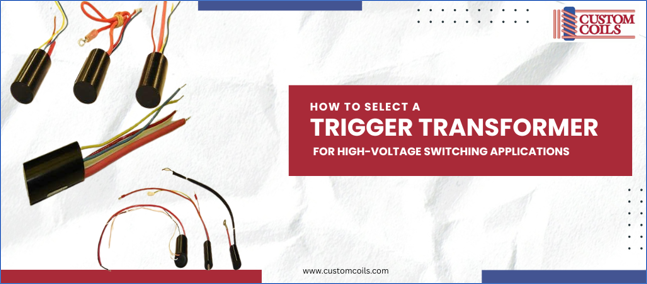
A trigger transformer also called a trigger pulse transformer or trigger coil transformer is a specialized high voltage pulse transformer that generates the short, high-voltage pulse needed to ionize a gas or gap so a larger discharge can begin. Unlike a conventional transformer, which transfers continuous power at a fixed frequency, it converts a low-voltage control signal into a single high-voltage pulse that initiates conduction in a flash lamp, laser, spark gap, or igniter. That’s why it’s specified by pulse voltage, width, and rise time rather than continuous power rating.
How Does a Trigger Transformer Work?
The primary winding receives a control pulse, and energy transfers to the secondary according to the turns ratio within the trigger transformer circuit. Because this is a single fast pulse, winding geometry, core material, and turns ratio all affect output quality a high ratio alone doesn’t guarantee a clean pulse without good coupling and core response.
External Triggering vs. Series Injection Triggering
Trigger transformers are applied in one of two configurations, and the choice affects size and electrical requirements.
External Triggering: Creates a thin ionized streamer between the anode and cathode from outside the discharge path. Since it doesn’t carry full discharge current, external triggering transformers are typically smaller and less expensive.
Series Injection Triggering: The energy storage capacitor discharges through the transformer’s secondary winding, so it must carry the full discharge current. These transformers are larger and can offer better timing accuracy, though the improvement depends on the specific circuit and load.
How to Choose Between the Two: External triggering suits compact, lower-cost applications that tolerate some timing variability; series injection suits applications where precise synchronization is critical.
Where Are Trigger Transformers Used?
- Military Targeting Lasers: Provide high-voltage trigger pulses for laser systems requiring reliable pulse initiation.
- Biomedical Lasers: Support reliable triggering in medical laser equipment.
- Laser Measuring Equipment: Provide controlled high-voltage pulses for laser-based measurement systems.
- Spark Switches: Generate the high voltage needed to initiate breakdown across a spark gap for high-voltage switching.
- Laser Flash Tubes: Initiate gas ionization in laser flash tubes before the main power supply drives the discharge.
- Xenon Lighting and Flash Tubes: Provide the high-voltage pulse required to initiate gas ionization.
- Igniters: Generate high-voltage pulses used to initiate ignition in applicable systems.
Key Specifications to Consider When Selecting a Trigger Transformer
- Output Pulse Voltage: The peak voltage required to initiate ionization across the target gap or within the gas. The required value depends on the load and triggering configuration.
- Pulse Width: The duration of the output pulse. It should be matched to the requirements of the triggered device and circuit.
- Rise Time: The time required for the pulse to rise from 10% to 90% of its peak amplitude. Winding configuration, leakage inductance, core characteristics, and the surrounding circuit can all influence rise time.
- Repetition Rate: The number of trigger pulses delivered over a given period. Higher repetition rates can increase thermal loading and may require the transformer and insulation system to be evaluated for the intended operating conditions.
- Isolation Requirements: The voltage the insulation system must withstand between windings and, where applicable, between windings and other conductive elements.
- Turns Ratio: The relationship between primary and secondary turns, which influences the voltage transformation. Turns ratio must be considered together with core and winding characteristics to achieve the required pulse performance.
Core and Winding Considerations
A highly permeable ferrite core supports efficient energy transfer. Winding configuration affects coupling, pulse shape, and transfer efficiency, and is commonly adjusted in custom designs for a specific coupling, isolation, or footprint need. Turns ratio sets the voltage step; winding layout determines how cleanly it arrives. Leakage inductance energy that doesn’t couple between windings can slow rise time and distort pulse shape.
High-Voltage Insulation and Isolation
High-voltage trigger applications place significant demands on insulation. Galvanic isolation prevents stray currents from passing between primary and secondary circuits, protecting the control circuit and downstream equipment. High-dielectric materials, such as specialized epoxies, encapsulate and insulate the windings to withstand high-voltage pulses reliably while also protecting them mechanically and environmentally.
Common Trigger Transformer Performance Challenges
Even a well-specified trigger transformer circuit can show performance issues if core, winding, or layout choices aren’t right:
- Voltage Droop: Output voltage decreases during the pulse due to magnetizing behavior, core, winding, or circuit characteristics.
- Slow Rise Time: Leakage inductance, winding coupling, and circuit parasitics can slow pulse rise time and affect triggering.
- Pulse Distortion: Core, winding, leakage inductance, parasitic effects, or the surrounding circuit can alter the pulse shape.
- Inadequate Energy Transfer: Poor core, winding, or coupling design can limit the energy delivered to the secondary.
When Do You Need a Custom Trigger Transformer?
A custom design is worth considering for a non-standard output or pulse voltage, specific pulse-width or rise-time targets, a turns ratio or winding configuration not available off the shelf, isolation above standard ratings, non-standard mounting, space constraints, application-specific encapsulation, or a particular triggering configuration.
Custom Coils designs and manufactures trigger pulse transformers in-house, offering external and series injection triggering with output voltages up to 60 kV and output power up to 2000 VA. Winding configuration, turns ratio, core selection, and encapsulation can all be tailored to a specific electrical, mechanical, thermal, and isolation requirement. Full specifications are on the trigger pulse transformers product page.
Choosing the Right Trigger Transformer for Your Application
Selecting the right trigger transformer means matching pulse voltage, pulse width, rise time, repetition rate, and turns ratio to the application, while ensuring core and winding design support clean, low-distortion pulse delivery. Isolation and encapsulation requirements layer on top a high voltage trigger transformer that meets the pulse spec but not the isolation requirement isn’t safe for high-voltage service.
When these requirements fall outside a standard part, a custom trigger transformer is generally the more reliable path. Contact Custom Coils’ engineering team or request a quote with your application details.
FAQ
What is a trigger transformer?
A trigger transformer is a specialized pulse transformer that converts a low-voltage control signal into a short, high-voltage pulse used to ionize a gas or gap. This ionization initiates conduction in devices such as flash lamps, lasers, and spark gaps, after which the main discharge circuit takes over.
What is the difference between a trigger transformer and a pulse transformer?
A pulse transformer is a broader category covering any transformer designed to handle pulsed rather than continuous waveforms. A trigger transformer is a specific type of high voltage pulse transformer purpose-built to generate the high-voltage ionization pulse used in triggering applications like flash lamps and lasers.
What causes voltage droop in a trigger transformer?
Voltage droop a decline in output pulse voltage during the pulse is generally caused by increasing magnetizing current as the pulse progresses. It’s addressed through core and winding design choices that account for this behavior over the pulse duration.
When is a custom trigger transformer required?
A custom design is generally needed when voltage, pulse width, rise time, turns ratio, isolation level, mounting style, or space constraints fall outside standard product ranges. Custom Coils can adjust winding configuration, core selection, and encapsulation in-house to meet application-specific requirements.