
A flyback transformer is a magnetic component used in switching power supplies to store energy during one part of a switching cycle and transfer that energy to the output during another. Unlike a conventional transformer, it does not transfer energy continuously from the primary to the secondary. Instead, energy is first stored in the magnetic field and then released when the switching device turns off.
The design of a flyback transformer directly affects energy storage, voltage conversion, efficiency, isolation, thermal performance, and overall reliability. For this reason, core selection, winding configuration, operating voltage, switching frequency, and physical dimensions all need to be considered together when developing a transformer for a specific application.
Custom Coils designs and manufactures custom magnetic components based on the electrical, mechanical, and environmental requirements of the application.
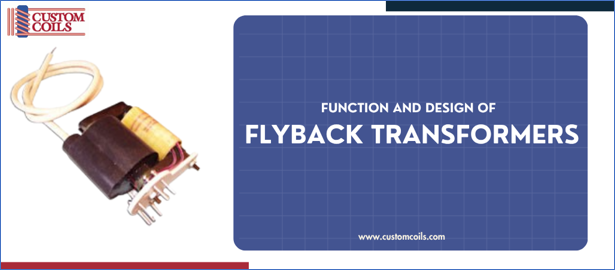
What Is a Flyback Transformer?
A flyback transformer is a coupled magnetic component primarily used in isolated switching power supplies and flyback converters. Its main characteristic is its ability to store energy in the magnetic field of the core while the primary switch is conducting and release that energy to the secondary side when the switch turns off.
This operating method makes flyback transformers useful in applications that require voltage conversion and galvanic isolation in a relatively compact design. Depending on the converter configuration, the output can be stepped up or down, and multiple secondary outputs can also be provided.
What Is the Function of a Flyback Transformer?
The function of a flyback transformer is to store and transfer energy while providing voltage conversion and electrical isolation between the input and output circuits.
During the switching cycle, energy is stored in the magnetic field and then transferred to the output. This means the transformer must meet several requirements at the same time. Its core must store the required energy without reaching saturation, while the windings need to handle the expected current and voltage stresses. The insulation system must also provide the required isolation between the primary and secondary circuits.
This combination of energy storage, voltage conversion, and isolation makes flyback transformer design different from that of a conventional power transformer.
How Does a Flyback Transformer Work?
The operation of a flyback transformer is closely connected to the switching cycle of the converter.
When the switching device turns on, voltage is applied to the primary winding and current begins to increase. During this interval, energy is stored in the magnetic field of the core. The secondary winding is arranged so that it does not transfer energy to the output while the primary switch is on.
When the switching device turns off, the magnetic field collapses and the stored energy is transferred through the secondary winding to the output circuit. The output capacitor and load then receive the transferred energy.
This store-and-release process is the basic operating principle behind flyback converter design. The transformer must store enough energy during each switching cycle while maintaining an appropriate flux level and avoiding core saturation.
Key Elements of Flyback Transformer Design
Several factors determine the performance and reliability of a flyback transformer:
- Core Selection: Ferrite cores are commonly used because of their suitable magnetic properties and low losses at switching frequencies. Core size, operating frequency, stored energy, flux density, and air gap must be considered to prevent saturation and excessive losses.
- Winding Design: Flyback transformer winding design determines the turns ratio, current capacity, leakage inductance, insulation, and voltage distribution. Proper conductor sizing and winding arrangement help control losses, temperature rise, voltage spikes, and parasitic effects.
- Voltage, Power, and Frequency: Input and output voltage, power, switching frequency, and duty cycle work together to determine the transformer design. Higher frequencies can reduce component size but may also increase core and switching losses.
- Flyback Transformer Construction: Construction typically includes a ferrite core, primary and secondary windings, bobbin, and insulation system. Depending on the application, varnish, epoxy, or other encapsulation may be used for insulation, mechanical stability, environmental protection, or thermal performance.
What Should You Consider When Designing a Flyback Transformer?
A reliable design starts with clearly defined electrical and mechanical requirements. Important parameters include:
- Input voltage and allowable input range
- Required output voltage and output power
- Switching frequency and duty cycle
- Primary inductance and turns ratio
- Peak and RMS winding currents
- Leakage inductance requirements
- Core material, geometry, and air gap
- Isolation and insulation requirements
- Operating temperature
- Available package or mounting space
- Environmental and application-specific requirements
These specifications help determine the appropriate core, winding configuration, insulation system, and construction method before manufacturing begins.
When Do You Need a Custom Flyback Transformer?
A custom flyback transformer may be needed when a standard component cannot meet the application’s specific voltage, power, frequency, dimensions, isolation, multiple-output, or thermal requirements. High-voltage applications may also require specialized insulation, creepage and clearance, and winding arrangements.
Custom Coils designs and manufactures flyback transformers based on the application’s electrical, mechanical, thermal, and insulation requirements.
If your application requires a flyback transformer with specific voltage, power, frequency, dimensions, or isolation requirements, request a quote from Custom Coils.
Frequently Asked Questions
What is a flyback transformer used for?
A flyback transformer is primarily used in switching power supplies and converters where energy storage, voltage conversion, and galvanic isolation are required within a compact magnetic component.
What is important in flyback transformer design?
Core selection, primary inductance, turns ratio, winding configuration, leakage inductance, operating frequency, voltage, power, and insulation requirements are among the key design considerations.
How is a flyback transformer different from a conventional transformer?
A conventional transformer generally transfers energy continuously through magnetic coupling, while a flyback transformer stores energy in its magnetic field and transfers that energy to the secondary side during a different part of the switching cycle.
When should I choose a custom flyback transformer?
A custom design is useful when standard transformers cannot meet requirements for voltage, power, frequency, dimensions, isolation, multiple outputs, thermal performance, or other application-specific specifications.
Can Custom Coils manufacture a flyback transformer to specific requirements?
Yes. Custom Coils can design and manufacture flyback transformers according to application-specific electrical, mechanical, thermal, and insulation requirements.